
Callouts aren't going away. Here's how cross-training turns every shift into a resilient one — and the structure that makes it work without chaos.
.svg)
7 min read
April 30, 2026
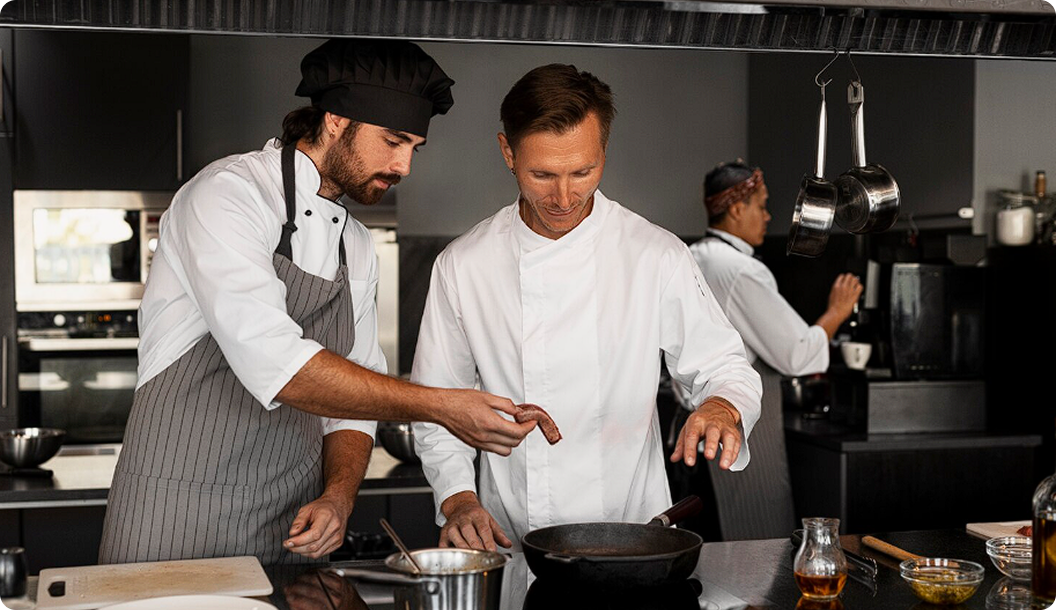
Every operator knows the feeling. Saturday at 4:15pm. Two call-outs. A line out the door at 5:30. Your schedule was tight to begin with, and now you're praying the dish pit holds up and your hostess can run drinks.
The honest truth is that the post-pandemic labor environment isn't going back to normal. Callout rates are structurally higher than they were five years ago. The operators who've adapted aren't the ones with better schedules — they're the ones who've trained their teams to flex across stations when the schedule breaks.
Cross-training used to be a nice-to-have. In 2026 it's a survival mechanism, and the operators treating it as a first-class training priority are outperforming their peers on every resiliency metric that matters.
A team where every person does exactly one job is a team with zero redundancy. Every call-out creates a hole that someone has to improvise around. The manager ends up on the line or on the floor. Service quality degrades in ways guests notice.
A cross-trained team has options. A server who can run food. A bartender who can expo. A host who can bus a table properly. None of them need to be experts in the second station — they need to be competent enough that a 30% coverage gap doesn't become a 100% failure.
Trying to cross-train everyone on everything is how cross-training dies. Nobody has the time and nobody gets good at anything. The framework that works: every team member has a primary station and one secondary station they can execute at an acceptable level.
Pair stations intentionally. Servers cross to food running and bussing. Bartenders cross to expo. Line cooks cross to adjacent stations, not every station. Hosts cross to seating-adjacent tasks, not to the kitchen. Logical adjacencies make training faster and transitions smoother.
Most training materials assume the person going through them will work that station as their main job. Cross-training needs a different kind of content: shorter, focused on the critical 20% of tasks, with clear escalation paths for edge cases.
A server cross-training to food running doesn't need the full runner's onboarding. They need to know ticket order, table positioning, hand-off etiquette, and when to escalate. A tight 30-minute cross-training module gets them functional. The full runner's training would overwhelm and demotivate them.
Cross-training that only gets used in emergencies isn't cross-training — it's hoping. The operators making this work actively deploy cross-trained coverage on slow shifts. Tuesday lunch is when the server-who-can-run-food runs food. By Saturday night, the muscle memory is there and the first real test isn't the first time they've done it.
Ten or fifteen minutes of deliberate cross-station time per shift, per person, builds the depth you'll need when you actually lose two people to call-outs on a Saturday.
Cross-trained team members are more valuable. Pay structure, scheduling priority, or formal recognition should reflect that. If the reward for cross-training is just being asked to do more work when things go wrong, nobody will want to cross-train.
Operators who attach real value to the skill — a small hourly differential, priority in scheduling, first access to advancement — build teams where cross-training is aspirational. Ones who treat it as an obligation build teams where it's quietly resisted.
The payoff for a well-cross-trained team shows up in every callout, every unexpected rush, every manager's day off. A team that can flex is a team that doesn't require the GM to drop into the hole every time someone's sick.
That's hours back in the manager's week and a service experience that doesn't collapse when the schedule does. For a single-unit operator it's breathing room. For a multi-unit operator it's the difference between a scalable operation and a fragile one.
Trensli builds role-based paths and secondary-station modules into a single platform, so cross-training is structured instead of improvised. Book a demo to see what a flex-ready team looks like on your menu and your stations.
.png)
The old 90-day ramp is no longer survivable economically. Here's how operators are compressing opening timelines without sacrificing standards. Primary Keyword: restaurant opening timeline
Trensli Team ·
April 30, 2026
· 6 min read
.png)
Gen Z now dominates hourly hospitality hires. Here's why the old training binder fails them, and the mobile-first, role-based approach that's replacing it.
Trensli Team ·
April 24, 2026
· 6 min read

Millions of guests on Ozempic and Wegovy are ordering differently. Here's what the GLP-1 trend means for your menu, your servers, and how you train them.
Trensli Team ·
April 24, 2026
· 6 min read


.png)